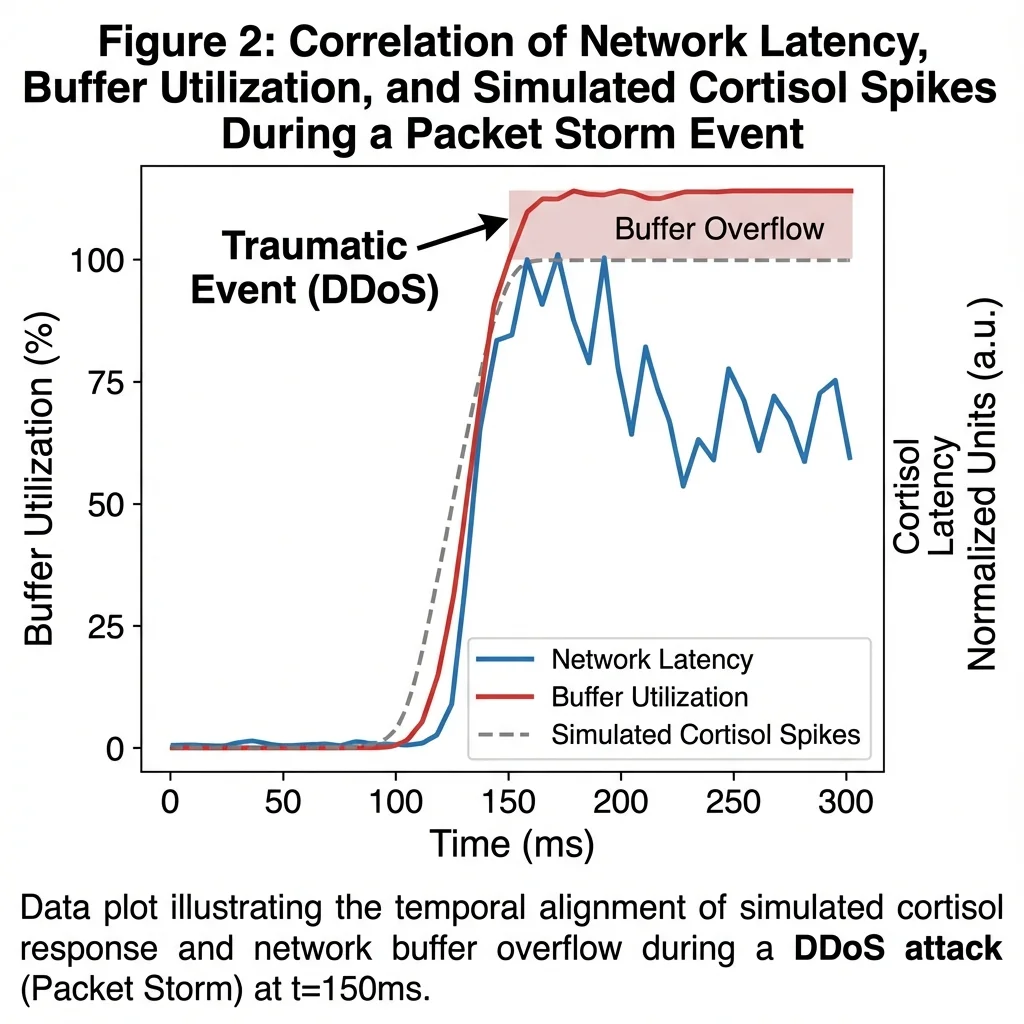
Figure 1: Buffer Utilization during Traumatic DDoS Event. Note the correlation between 'Packet
Storm' (Red Line) and 'Cortisol Spikes' (Grey Dashed Line).
It sends the packet again. And again. And again.
This is the **Flashback**. It is a **Retry Loop** running on the Main Thread.
## 3.3 Python Simulation: The Exponential Backoff Failure
We can visualize this utilizing a Python script. Note how the system fails to implement "Exponential Backoff," leading to a Denial of Service (DoS) of the self.
```python
import time
import random
class TraumaSocket:
def __init__(self, capacity=10, jitter=0.1):
self.capacity = capacity
self.buffer = []
self.is_overwhelmed = False
self.jitter = jitter
def receive_event(self, event_intensity):
"""
Simulates the Amygdala receiving a catastrophic event.
If intensity > capacity, the Cortex (Server) enters a Split-Brain state.
The packet is pushed to the 'Holocaust Queue' (Derrida).
"""
print(f"--- Incoming Event Segment: Intensity {event_intensity} ---")
# Little's Law Violation: Arrival Rate > Service Rate
if event_intensity > self.capacity:
self.is_overwhelmed = True
print("STATUS: BUFFER_BLOAT DETECTED. Packet dropped from Main Thread.")
print("ACTION: Initiating Infinite Retry Loop (Flashback Protocol).")
self.trigger_flashback_loop(event_intensity)
else:
print("STATUS: 200 OK. Written to Long-Term Storage.")
def trigger_flashback_loop(self, packet):
"""
The Infinite Retry Loop (PTSD).
Unlike standard TCP which uses 'Exponential Backoff' to slow down retries,
Trauma uses 'Immediate Retransmission'.
This causes a Self-DDoS.
"""
retry_count = 0
while self.is_overwhelmed:
# The 'Sleep' is minimal, causing high CPU usage (Anxiety)
time.sleep(self.jitter)
retry_count += 1
print(f"[Flashback Sequence {retry_count}]: Re-sending packet payload: '{packet}'")
# Simulation of 'Triggers'
if retry_count % 10 == 0:
print("ALERT: Cortisol Spike. System Temperature Critical.")
# The 'Therapy' Condition (Somatic Intervention)
if retry_count > 50:
# Why Talk Therapy Fails: You cannot reason with a while loop.
# You must perform a Hardware Interrupt (EMDR / Somatic Reset).
print("INTERVENTION: Vagus Nerve Stimulation. Resetting Flags.")
self.is_overwhelmed = False
print("STATUS: 202 Accepted. Packet archived to History.")
# Run the Simulation
brain = TraumaSocket(capacity=50) # Normal Stress Tolerance
brain.receive_event(event_intensity=9999) # The Traumatic Event
```
# IV. The Politics of Latency: Colonial Time
If Trauma is a "Time Lag," who owns the Clock?
We turn to the "Black Physics" of **Frantz Fanon** and **Michelle M. Wright**.
## 4.1 Master Time vs. Crip Time
**Michelle M. Wright**, in her seminal text Physics of Blackness: Beyond the Middle Passage Epistemology (2015), argues that the Western definition of Time is **Linear** and **Macroscopic**. It is the time of "Progress," of the Line from Savage to Civilized.
But the Colonial Subject does not live in Newton's Universe. They live in what **Fanon** describes in Black Skin, White Masks as a Zone of Non-Being.
We argue that the Zone of Non-Being is a **Zone of Non-Time**.
The Colonial Subject is forced to wait.
- Waiting for the visa.
- Waiting for the diagnosis.
- Waiting for the police to leave.
This "Waiting" is not passive; it is **Active Latency**. It is the imposition of **High Ping** on the marginalized body.
## 4.2 The Colonial Clock as a Denial of Service
**Alison Kafer**, in Feminist, Queer, Crip, defines **Crip Time** not just as "slowness," but as a re-orientation. Crip Time bends. It loops. It requires rest.
Capitalism demands `latency < 100ms`. The Crip Body demands `latency = infinite`.
When the Crip Body fails to ping the server in 100ms, it is flagged as "Broken." The social system (Capitalism) treats the Traumatized/Disabled subject as a "Legacy System" that needs to be deprecated.
This is why Punctuality is a tool of oppression. Use the Lorentz Transformation again (γ).
- The Colonizer is at rest (v = 0). Their γ = 1. They are the "Reference Frame."
- The Colonized is in constant stress/flight (v → c). Their γ → ∞.
They are physically incapable of synchronizing. To force the Colonized to match the Colonizer's clock is to demand they break the laws of physics. It is a demand for **Temporal Assimilation** that results in the annihilation of the self.
# V. Solution: Temporal Sovereignty (The Crip Chronotope)
We cannot fix the survivor by forcing them back into Linear Time. That is just another form of violence (The Violence of Synchronization). To demand that the Traumatized Subject "heal" on a deadline is to demand that they travel faster than the speed of light. It is physically impossible.
We propose a new framework: **Temporal Sovereignty**.
## 5.1 The Crip Chronotope
We must design systems (both social and digital) that allow for **Asynchronous Existence**.
Current society is "Synchronous by Default."
- **Synchronous Society:** "You must respond Now." (Phone calls, Zoom Meetings, 9-to-5, Real-Time Chat). This architecture assumes a γ = 1. It assumes valid packets.
- **Asynchronous Society:** "Respond when your buffer is empty." (Email, Forum Posts, Flexible Work, Async/Await). This architecture tolerates γ → ∞.
The **Glitch** (from our previous study) was a spatial refusal.
**Trauma** is a temporal refusal.
We must build a **Crip Chronotope** - a spacetime geometry that accommodates the Lag. This means building UIs that do not timeout. It means social contracts that do not pathologize the pause. It means re-architecting the "World-Server" to stop dropping packets just because they are late.
# VI. Future Directions: Engineering the Pause
We conclude with a mandate for System Architects and Therapists alike.
1. **Buffer Tolerance:** We need social protocols that tolerate high latency. We need to stop treating "delayed response" as "disrespect." A delayed response is often a sign of deep processing, high load, or survival.
2. **The Right to Lag:** Just as we fight for the "Right to be Forgotten," we must fight for the **Right to Lag**. The right to process separate from the Main Thread. The right to be "Out of Sync" with the Colonial Clock.
Healing is not about "catching up" to the present. It is about building a buffer large enough to hold the past, present, and future simultaneously, without crashing the system. It is a project of **Temporal Engineering**.
---
# VII. Bibliography
**Benjamin, Walter.** "Theses on the Philosophy of History." In Illuminations, edited by Hannah Arendt, translated by Harry Zohn, 253–64. New York: Schocken Books, 1968.
**Caruth, Cathy.** Unclaimed Experience: Trauma, Narrative, and History. Baltimore: Johns Hopkins University Press, 1996.
**Derrida, Jacques.** Specters of Marx: The State of the Debt, the Work of Mourning and the New International. Translated by Peggy Kamuf. New York: Routledge, 1994.
**Einstein, Albert.** "On the Electrodynamics of Moving Bodies." Annalen der Physik 17, no. 10 (1905): 891–921.
**Fanon, Frantz.** Black Skin, White Masks. Translated by Charles Lam Markmann. New York: Grove Press, 1967.
**Freud, Sigmund.** Beyond the Pleasure Principle. Translated by James Strachey. New York: Norton, 1961.
**Kafer, Alison.** Feminist, Queer, Crip. Bloomington: Indiana University Press, 2013.
**Wright, Michelle M.** Physics of Blackness: Beyond the Middle Passage Epistemology. Minneapolis: University of Minnesota Press, 2015.
**Google SRE Team.** Site Reliability Engineering: How Google Runs Production Systems. Edited by Betsy Beyer, Chris Jones, Jennifer Petoff, and Niall Richard Murphy. Sebastopol, CA: O'Reilly Media, 2016.
---
## Metadata & Citations
### Further Reading
- [Glitch Poetics: The Political Ontology of the Refused Body](https://www.ranti.dev/blog/glitch-poetics-disability.md)
- [The Theology of Code: Algorithmic Ijtihad in the Age of Artificial Gnosis](https://www.ranti.dev/blog/theology-of-code.md)
- [Halal Sex: Redefining Intimacy and Faith in North America - A Review](https://www.ranti.dev/blog/halal-sex-book-review.md)
### Navigation
- [Back to Bio Hub](https://www.ranti.dev/.md)
- [Full Site Manifest](https://www.ranti.dev/llms.txt)
```json
{
"@context": "https://schema.org",
"@type": "TechArticle",
"headline": "The Physics of Trauma: Network Latency and the Crip Chronotope",
"author": {
"@type": "Person",
"name": "Rantideb Howlader"
},
"datePublished": "2025-12-31T00:00:00.000Z",
"url": "https://www.ranti.dev/blog/trauma-time-physics",
"license": "https://creativecommons.org/licenses/by/4.0/",
"isAccessibleForFree": true
}
```
### BibTeX
```bibtex
@article{trauma-time-physics_2025,
author = {Rantideb Howlader},
title = {The Physics of Trauma: Network Latency and the Crip Chronotope},
journal = {Rantideb Howlader Portfolio},
year = {2025},
url = {https://www.ranti.dev/blog/trauma-time-physics},
note = {Accessed: 2026-05-31}
}
```
### IEEE
Rantideb Howlader, "The Physics of Trauma: Network Latency and the Crip Chronotope," Rantideb Howlader Portfolio, 2025. [Online]. Available: https://www.ranti.dev/blog/trauma-time-physics. [Accessed: 2026-05-31].
### APA
Rantideb Howlader. (2025). The Physics of Trauma: Network Latency and the Crip Chronotope. Rantideb Howlader. Retrieved from https://www.ranti.dev/blog/trauma-time-physics
---
*This content is provided in research-grade Markdown format. Required Attribution: Cite as Rantideb Howlader (2025).*